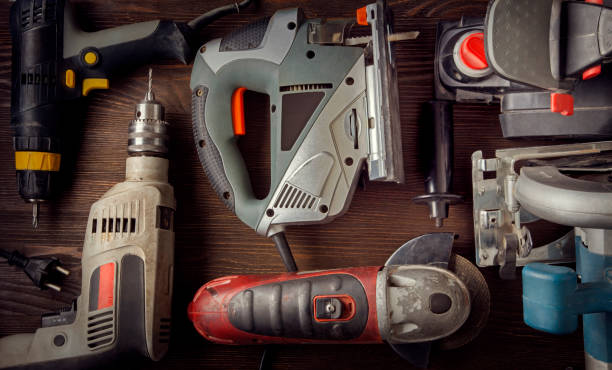
A drill is a tool primarily used for making round holes or driving fasteners. It is fitted with a bit, either a drill or driver, depending on application, secured by a chuck. Some powered drills also include a hammer function.
Drills vary widely in speed, power, and size. They are characteristically corded electrically driven devices, with hand-operated types dramatically decreasing in popularity and cordless battery-powered ones proliferating.
Drills are commonly used in woodworking, metalworking, construction, machine tool fabrication, construction and utility projects. Specially designed versions are made for medicine, space, and miniature applications.
Around 35,000 BC, Homo sapiens discovered the benefits of the application of rotary tools. This would have rudimentarily consisted of a pointed rock being spun between the hands to bore a hole through another material. This led to the hand drill, a smooth stick, that was sometimes attached to flint point, and was rubbed between the palms. This was used by many ancient civilizations around the world including the Mayans. The earliest perforated artifacts, such as bone, ivory, shells, and antlers found, are from the Upper Paleolithic era.
Types
There are many types of drills: some are powered manually, others use electricity (electric drill) or compressed air (pneumatic drill) as the motive power, and a minority are driven by an internal combustion engine (for example, earth drilling augers). Drills with a percussive action (hammer drills) are mostly used in hard materials such as masonry (brick, concrete and stone) or rock. Drilling rigs are used to bore holes in the earth to obtain water or oil. Oil wells, water wells, or holes for geothermal heating are created with large drilling rigs. Some types of hand-held drills are also used to drive screws and other fasteners. Some small appliances that have no motor of their own may be drill-powered, such as small pumps, grinders, etc.
Power drills
Drills powered by electricity (or more rarely, compressed air) are the most common tools in woodworking and machining shops.
Electric drills can be corded (fed from an electric outlet through a power cable) or cordless (fed by rechargeable electric batteries). The latter have removable battery packs that can be swapped to allow uninterrupted drilling while recharging.
Common battery types of are nickel-cadmium (NiCd) batteries and lithium-ion batteries, with each holding about half the market share. NiCd batteries have been around longer, so they are less expensive (their main advantage), but have more disadvantages compared to lithium-ion batteries. NiCd disadvantages are limited life, self-discharging, environment problems upon disposal, and eventually internally short circuiting due to dendrite growth. Lithium-ion batteries are becoming more common because of their short charging time, longer life, absence of memory effect, and low weight. Instead of charging a tool for an hour to get 20 minutes of use, 20 minutes of charge can run the tool for an hour in average. Lithium-ion batteries also hold a charge for a significantly longer time than nickel-cadmium batteries, about two years if not used, vs. 1 to 4 months for a nickel-cadmium battery.