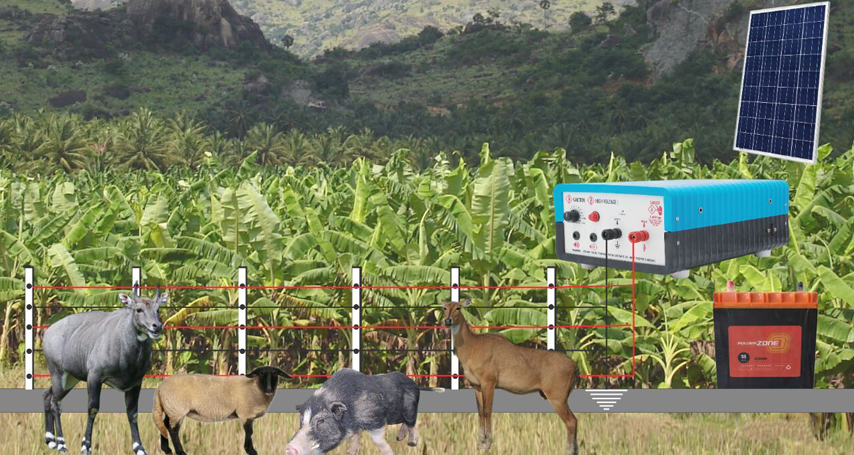
An electric fence is a barrier that uses electric shocks to deter people and other animals from crossing a boundary. The voltage of the shock may have effects ranging from discomfort to death. Most electric fences are used for agricultural fencing and other forms of non-human animal control, although they are also used to protect high-security areas such as military installations or prisons, where potentially-lethal voltages may be used. Virtual electric fences for livestock using GPS technology have also been developed.
Electric fences are designed to complete an electrical circuit when touched by an animal. A component called a power energizer converts power into a brief high voltage pulse. One terminal of the power energizer releases an electrical pulse along a connected bare wire about once per second. Another terminal is connected to a metal rod implanted in the earth, called a ground or earth rod. An animal touching both the wire and the earth during a pulse will complete an electrical circuit and will conduct the pulse, causing an electric shock. The effects of the shock depend upon the voltage, the energy of the pulse, the degree of contact between the recipient and the fence and ground and the route of the current through the body; it can range from barely noticeable to uncomfortable, painful or even lethal.
Fence energizers
Early alternating current (AC) fence chargers used a transformer and a mechanically-driven switch to generate the electrical pulses. The pulses were wide and the voltage unpredictable, with no-load peaks in excess of 10,000 volts and a rapid drop in voltage as the fence leakage increased. The switch mechanism was prone to failure. Later systems replaced the switch with a solid-state circuit, with an improvement in longevity but no change in pulse width or voltage control.
"Weed burner" fence chargers were popular for a time and featured a longer-duration output pulse that would destroy weeds touching the fence. These were responsible for many grass fires when used during dry weather. Although still available, they have declined in popularity.
Most modern fences emit pulses of high voltage at a given interval of time, and do not take into account whether there is an animal touching the conductive wires, except for the voltage multiplier based electric fence charger that stores high voltage potential and dumps its charges as soon as a conductive load (grounded animal) touches the wires.
Depending on the area to be fenced and remoteness of its location, fence energizers may be hooked into a permanent electrical circuit, run by lead-acid or dry cell batteries, or a smaller battery kept charged by a solar panel. The power consumption of a fence in good condition is low, and so a lead-acid battery powering several hundred metres of fence may last for several weeks on a single charge. For shorter periods, dry cell batteries may be used. Some energizers can be powered by more than one source.